by Bhikkhu Samahita
What are these SIX directions:
First Direction - Children/Parents
Second Direction - Students/Teachers
Third Direction - Wife/Husband
Fourth Direction - Friends/Friends
Fifth Direction - Employees/Employer
Sixth Direction - Lay Buddhist/Sangha
First direction: How should Children behave towards Parents and Parents behave towards children?
1. Having been raised by them, one looks after them in return.
2. One helps them in their business and work.
3. One continues & maintains the family line.
4. One conducts oneself as is proper for an heir.
5. After their death, one makes offerings, dedicating the merit to them.
Parents should help their children by:
1. Cautioning and protecting them from evil.
2. Nurturing and training them in goodness.
3. Providing a suitable & proper education.
4. Seeing to it that they obtain suitable spouses.
5. Bequeathing the inheritance to them at the right time.
Click at "Read more..." to continue
Second direction: How should Students behave towards Teachers and Teachers behave towards students?
Students should respect their teachers by:
1. One rises to greet the teacher when he arrives and shows respect towards the teacher.
2. One approaches the teacher to attend to & serve him, to consult, to query & to receive advice from him.
3. One listens well & pay full undivided attention so as to gain complete understanding.
4. One performs any practical task and runs errands for the teacher.
5. One learns the subject earnestly, giving this task of learning right priority.
Teachers should support his students by:
1. Teaching and training them to be good and skilful.
2. Guiding them to thorough & penetrating understanding.
3. Teaching the subject in full, holding nothing back.
4. Encouraging and praising the student's qualities and abilities.
5. Providing learning that both can make a living & induce behaviour producing happy prosperity.
Third direction: How should Husband behave towards Wife and Wife behave towards Husband?
1. One honours her in accordance with her status as a wife.
2. One does not disparage, criticize, undervalue or belittle her.
3. One does not commit adultery with any other women.
4. One gives her control of & responsibility for all the household affairs.
5. One gives her occasional gifts of ornaments and clothing.
A wife supports her husband by:
1. Keeping the household clean, proper and tidy.
2. Helping the relations and friends of both family sides.
3. Not committing adultery with any other men.
4. Safeguarding any wealth that has been acquired.
5. Being energetic and enduring in all her works.
Fourth direction: How should Friend behave towards Friend?
A real friend maintains his friendships by:
1. He shares with them.
2. He speaks kindly to and about them.
3. He helps them whenever needed.
4. He is constant & faithful despite their ups and downs.
5. He is understanding and sincere.
Friends then reciprocate by:
1. Protecting their friend when he is off guard.
2. Protecting their friend's property when one is off guard.
3. Being a safe refuge and shelter in times of danger.
4. Not desert or leave their good friend in times of need.
5. Respecting all their friend's family and relations.
Fifth direction: How should Employer behave towards employees, & Employees towards employer?
2. He pays them wages compatible with their work and adequate for their livelihood.
3. He grants them fringe benefits and provides medical care in times of sickness.
4. He shares with them a portion of any special profits that may arise.
5. He gives them appropriate holidays and suitable time to rest.
The Employee helps the employer by:
1. Starting work before the employer.
2. Stopping work after the employer.
3. Taking only what is given by his employer.
4. Doing the job well and always seeking ways to improve on it.
5. Spreading a good reputation about the employer and his business.
Sixth direction: How should the lay Buddhist behave towards monks and nuns, & they towards him?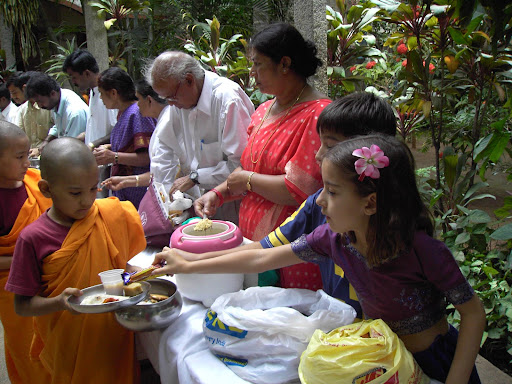
The Lay Buddhist honours and respects the ordained Sangha by:
1. He acts towards them in goodwill.
2. He speaks to them with goodwill.
3. He thinks of them with goodwill.
4. He receives them willingly.
5. He supports them with the four requisites of almsfood, robes, shelter and medicine.
All Monks and nuns help the lay people by:
1. Protecting them from evil actions which inevitably produces painful consequences.
2. Encouraging them in goodness, which inevitably produces pleasurable consequences. .
3. Assisting them in all activities with kind intentions.
4. Making known to them the things they have not heard before.
5. Enhancing and clarifying those things they have already heard.
6. Pointing out the way to heaven, & teaching them the way to happy prosperity here & now.
Source:
A constitution for Living. Buddhist Principles for a Fruitful and Harmonious Life.
Ven. P.A. Payutto. Thailand. Buddhist Publication Society 2007: BP 620S
http://www.bps.lk
Tuesday, July 8, 2008
Maintain good and sound social relations in all SIX directions


Dear Brothers & Sisters in the Dhamma,
The below sermon was delivered by Ven. B. Sri Saranankara Nayaka Maha Thera, Chief Monk of Sri Lanka Buddhist Temple and Chief High Priest (Judiciary) of Malaysia during the Mother’s Day Appreciation Dinner on 11th May 2008 at the Sri Lanka Buddhist Temple, Sentul, KL. This sermon was inspired by the Sigalovada Sutta delivered by the Buddha.
Buddha’s Path to Happy Parents and Children
By Ven. B. Sri Saranankara Nayaka Maha Thera
5 Duties of Parents towards Children
1. Dissuading Children from Bad Habits
We live in a world, where a child is exposed to negative messages since small. A world that teaches our children to strive for power, fame, status and entertainment. Children develop habits like instant gratification, lying, cheating, disloyalty and looking out only for oneself. It is the duty of parents to prevent children from being exposed to these negative messages especially from movies, magazines, music and the internet.
2. Persuading Children to Do Good
Parents must continuously expose children to positive information, values and habits. Parents themselves must be an example of virtuous living. Children must be brought to the temples and if possible be enrolled in the Sunday Dhamma School. Parents and children must visit the temple often, participate in spiritual and welfare activities and most importantly learn and practice the Buddha’s teachings. They should develop a meaningful relationship with the monks and other lay devotees. The family must daily pray and meditate together and practice the 5 precepts in everyday life.
3. Giving the Children a Good Education
It is the duty of parents to provide a good education for their children, both spiritual and secular. They should learn the interest and talents of their children and guide them to learn and develop skills that will help them to obtain a right livelihood. They should encourage their children to follow their dreams according to their likings and talents. Parents must find a career for their children that will help them serve society in a meaningful and wholesome way.
4. Giving Them in Marriage to Suitable Individuals
In the modern world, it is quite common for children to find their own partners in marriage. Nevertheless, it is the duty of parents to have a say in their marriage selection. Most of the time, young people are attracted to a partner only in the physical sense. They fail to realize the challenges of marriage life. Their marriage will be successful if the couples can complement one another and share similar values and ambitions. Parents should assure their children choose marriage partners based on rationality, practicality and compatibility.
5. Handing over the Inheritance to the Children at the proper time
If parents have any inheritance to hand over to their children, it should be done at the proper time either before or after they pass away. Parents must prepare a will to transfer the wealth to their children and this division of wealth should be fair to all their children. If they pass away without leaving a will, this might cause disharmony among the children when it comes to dividing the wealth.
5 Duties of Children towards Parents
1. Supporting the parents
If parents cannot support themselves due to monetary or health problems, it is the duty of children to provide them with this support during their old age. If parents no longer have a steady income, children should provide their parents with money to cover their expenses. They must make sure their parents have regular health checkups and take their medicines on time. If their parents cannot take care of themselves, they should care for their parents by bathing and feeding them.
2. Performing the necessary duties
It is the duty of children to care for the happiness and wellbeing of the parents. They should stay together with their parents and care for them. If this is not possible, they should visit their parents often. Encourage the grandchildren to spend time with their grandparents. Pay respect to their parents by including them in family activities like birthdays, weddings, outings, etc. If their parents are unable to attend religious functions at the temple, they should take them to the temple regularly to attend blessing services, chanting, dana and dhamma talks. If possible, parents should be taken on Buddhist pilgrimages. A child’s greatest duty to a parent is to keep them on the Dhamma path.
3. Keeping the family lineage
Whatever inheritance handed down by the parents, should be put to good use. Children should invest and safe guard the family inheritance so that it will continue to benefit the coming generations.
4. Honoring the name of their Parents
The Buddha advises, “Although man’s body decays and disappears, the name or influence he creates does not decay”. Children must protect the good name of the family. They should continue the good works of their parents, especially the spiritual and welfare services rendered by their parents to society. The children should continue the noble tradition of visiting the temple and supporting the Dhamma and Sangha.
5. Performing meritorious actions in the name of departed Parents.
After their parents have passed away, the children should regularly conduct religious services and transfer the merits to their departed parents. They can make donations to charitable activities and print Dhamma books in memory of their parents
Read more...
Monday, July 7, 2008
COFFEE & CUPS
Take some moments to reflect. Something nice to share…
e-mail received from Bee Leng
'The happiest people in the world are not those who have no problems, but those who learn to live with things that are less than perfect.'
When all the students had a cup of coffee, the professor said: 'If you noticed, all the nice looking expensive cups 


Click at "Read more..." to continue
Now consider this, said the professor, 'Life is the coffee; the jobs, money and position in society are the cups. They are just tools to hold and contain Life, and the type of cup we have does not define, nor change the quality of Life we live. Sometimes, by concentrating on the cup, we fail to enjoy the coffee we are drinking. '
The happiest people don't have the best of everything. They just make the best of everything. Four things to take note of in life...
1. Live simply.
2. Love generously without biasness.
3. Care deeply but do not cling.
4. Speak kindly.
Shine a light & enjoy your Coffee today!!
Read more...
Monday, June 30, 2008
A candle loses nothing if it is used to light another one.
A long time ago in China , a girl named Li-Li got married & went to live with her husband and mother-in-law. In a very short time, Li-Li found that she couldn't get along with mother-in-law at all. Their personalities were very different, and Li-Li was angered by many of her mother-in-law's habits. In addition, she criticized Li-Li constantly.
Days passed, and weeks passed. Li-Li and her mother-in-law never stopped arguing and fighting. But what made the situation even worse was that, according to ancient Chinese tradition, Li-Li had to bow to her mother-in-law and obey her every wish. All the anger and unhappiness in the house was causing Li-Li's poor husband great distress.
Finally, Li-Li could not stand her mother-in-law's bad temper and dictatorship any longer, and she decided to do something about it! Li-Li went to see her father's good friend, Mr. Huang, who sold herbs. She told him the situation and asked if he would give her some poison so that she could solve the problem once and for all.
Click at "Read more..." to continue
Mr. Huang thought for a while, and finally said, 'Li-Li, I will help you solve your problem, but you must listen to me and obey what I tell you.'
Li-Li said, 'Yes, Mr. Huang, I will do whatever you tell me to do.' Mr Huang went into 
Weeks went by, and months went by, and every other day, Li-Li served the specially treated food to her mother-in-law. She remembered what Mr. Huang had said about avoiding suspicion, so she controlled her temper, obeyed her mother-in-law, and treated her like her own mother.
The mother-in-law's attitude toward Li-Li changed, and she began to love Li-Li like her own daughter. She kept telling friends and relatives that Li-Li was the best daughter-in-law one could ever find. Li-Li and her mother-in-law were now treating each other like a real mother and daughter. Li-Li's husband was very happy to see what was happening.
One day, Li-Li came to see Mr. Huang and asked for his help again She said, 'Dear Mr. Huang, please help me to keep the poison from killing my mother-in-law. She's changed into such a nice woman, and I love her like my own mother. I do not want her to die because of the poison I gave her.'
Mr. Huang smiled and nodded his head. 'Li-Li, there's nothing to worry about. I never gave you any poison. The herbs I gave you were vitamins to improve her health. The only poison was in your mind and your attitude toward her, but that has been all washed away by the love which you gave to her.'
There is a wise Chinese saying: 'The person who loves others will also be loved in return.
Read more...
